Strengthening Awareness Through Practice
After you shift from being the thought to becoming the thinker, the next step is learning to stay in that awareness.

Introducing new, non-routine activities helps interrupt these old pathways.
When you step into something new — even something small — your awareness wakes up.
Examples:
Taking a different route for your walk
Learning a new skill
Trying creative expression
Spending silent time in nature
Reading something outside your usual pattern
Changing a small part of your daily routine
These experiences shake the mind out of autopilot.
They loosen the influence of childhood conditioning and make space for new inner growth

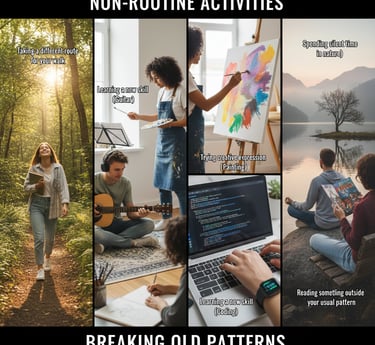
Non-Routine Activities: Breaking Old Patterns
The Lower Mind thrives on repetition. It grows stronger every time you repeat the same reactions, same habits, and same emotional cycles.
Methods
Now that you’ve seen how we collect our inner “luggage,” let’s explore simple practices.
This happens through simple, steady practices that help you rise above old patterns and awaken new clarity.
Three most powerful practices are meditation, non-routine activities and thoughts classification.

Meditation


Meditation: Deepening Your Inner Clarity
Meditation is the space where the mind slows down, and the Self becomes visible.
It is not about controlling thoughts — it is about creating room around them.
In meditation:
Thoughts begin to lose their intensity
Emotional reactions soften
Old patterns stop pulling you in
Awareness grows stronger than the Lower Mind
With consistent practice, meditation helps you:
See your thoughts without getting trapped in them
Recognise old reactions before they take over
Make calmer, wiser choices
Feel more grounded and centered
Meditation gently strengthens the Higher Mind — the part of you that sees clearly and lives in harmony.

Classifying Your Thoughts: Ignore • Negotiate • Block
IGNORE — Thoughts That Don’t Deserve Your Energy
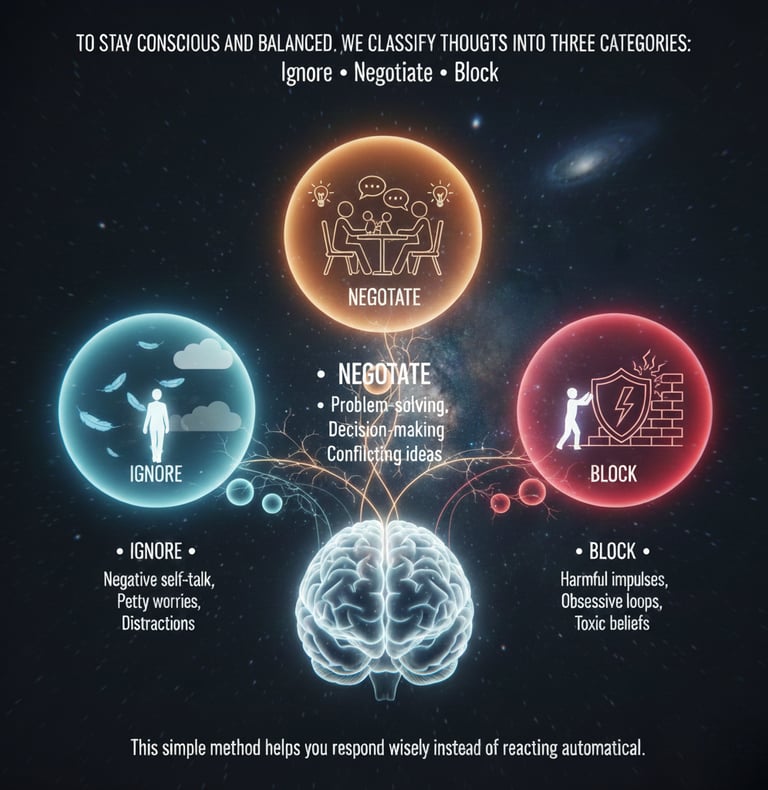
Some thoughts are just noise — random, unnecessary, or emotionally exaggerated.
These thoughts fade away on their own when you don’t feed them.
Examples of IGNORE thoughts:
“What if everyone is judging me right now?”
“Maybe I should check my phone again… just in case.”
“I should worry about this even though nothing is wrong yet.”
“Why did she look at me like that?”
These thoughts have no truth or purpose.
NEGOTIATE — Thoughts That Need Understanding, Not Action
Some thoughts come from deeper layers of your mind — fear, insecurity, old patterns, or desires.
These thoughts are not always right or wrong,
but they need to be questioned, understood, or balanced.
Examples of NEGOTIATE thoughts:
“I feel jealous. Why? What is this showing me?”
“I’m angry. Is this anger valid, or is it just my old reaction?”
“I feel like giving up. Is this exhaustion or my Lower Mind resisting change?”
“I want this badly. Is it good for me or just a craving?”
Negotiating doesn’t mean overthinking —
it means talking to yourself with awareness.
BLOCK — Thoughts That Are Harmful
Some thoughts directly drain your energy, damage your peace, or pull you into destructive habits.
These thoughts must be blocked immediately — not entertained, not analysed.
Examples of BLOCK thoughts:
“I should hurt myself.”
“Let me go back to my old addiction just once.”
“I am worthless.”
“I should get revenge.”
These thoughts are not “you.” They are the Lower Mind at its most intense.